
Revamping a website is often associated with a more modern design, faster loading times, or updated technology. But when a website has been attracting customers for years, the revamp is no longer just an aesthetic issue. It becomes a business challenge: how to improve it without jeopardizing what already works.
A few months ago, we found ourselves in exactly that situation. We had to choose between two very different ways of revamping a website. The project ended up confirming something we often advocate at Queiku: improving a website doesn’t always mean changing everything.
The starting point: an outdated website that was still generating business
The website was built on WordPress and was more than ten years old. The design had become outdated, and the installation had accumulated a large number of plugins and dependencies. Maintenance was becoming increasingly costly, and there were security and performance issues that required urgent attention.
There were plenty of reasons to consider a major overhaul. But the initial analysis revealed something crucial: the website was still generating business. Its search engine ranking had plenty of room for improvement, and yet several pages were still ranking well on Google for relevant industry searches. These pages were driving traffic and generating business opportunities.
Technically speaking, the website had significant shortcomings. For the company, however, it served an essential purpose. That distinction shaped the entire project: it wasn’t enough to consider what was technically desirable; we also had to assess how each decision would affect the client’s business.
Two ways to approach a website redesign
When a website has established a strong organic search ranking, there are two main ways to approach its further development.
Conservative renewal: improving without changing what works
Consiste en mantener lo que ya da resultados: contenidos relevantes, estructura de páginas, URLs y orientación de palabras clave. Sobre esa base se renueva la plataforma y se resuelven los problemas técnicos.
It’s not about keeping the flaws of the previous website. It’s about identifying what adds value and preserving it while working on the rest. A project like this can significantly improve design, performance, security, accessibility, and maintenance without overhauling the SEO strategy. It’s especially suitable when the business relies on organic traffic that shouldn’t be put at risk.
Strategic renewal: rethinking the website to drive growth
This is the most ambitious approach. It takes advantage of the redesign to review the content architecture, user experience, services, target keywords, and lead generation strategy. Instead of building on what already exists, it starts with the business, its market, and its opportunities.
These are projects we particularly enjoy because they allow us to challenge legacy decisions and design our strategy with greater freedom. They also involve more uncertainty. When URLs, content, or structure change significantly, Google needs to crawl and process those changes. As Google notes in its documentation on migrations, temporary fluctuations in search rankings may occur.
That doesn’t mean that a strategic overhaul will necessarily lead to a drop in traffic, nor that a conservative approach is risk-free. The difference lies in the scope of the changes and how much uncertainty the business can handle.
Our decision: to protect what was already working
We opted for a conservative redesign. The client relied on opportunities generated through the website and could not afford even a temporary disruption to that channel. A complete overhaul was appealing from our perspective, but it wasn’t the best approach for their situation.
Before making any changes, we conducted an SEO audit. We wanted to know which pages were driving traffic, which keywords were performing well, how users were finding the site, and what needed to be kept. This way, our decisions were based on data—not just on design or development criteria. We also established a plan for ongoing monitoring using Google Search Console and analytics tools.
The premise was clear: we weren’t going to replace the keywords that were already working, but rather give them a more technically robust platform.
The technical work behind the renovation
We retained the main content, the overall structure, and the relevant URLs, and avoided any unnecessary changes that might affect search rankings. With that foundation in place, we focused on two areas.
1. Performance and user experience
We focus on load speed, visual stability, and responsiveness, with special attention to the Core Web Vitals. These metrics measure how long it takes for the main content to load, how the page responds to interactions, and whether elements shift while the page is loading. Google recommends achieving good scores on these metrics, although it clarifies in its documentation that they alone do not guarantee higher rankings.
2. Technical and indexing issues
- Optimization of web infrastructure and resources.
- Troubleshooting image issues.
- Troubleshooting 404 Errors.
- Review of indexed pages with sparse or low-value content.
- Fixes issues carried over from the previous platform.
- Security improvements and removal of unnecessary dependencies.
These changes are not very noticeable to the user, and none of them alone guarantees an improvement in search rankings. Taken together, they remove obstacles that hinder crawling, improve navigation, and make the platform more reliable. That was the goal: to enable the website to make better use of the search rankings it already had.
The results
Following the launch of the new website in late May 2026, data from Google Search Console showed a very positive trend.
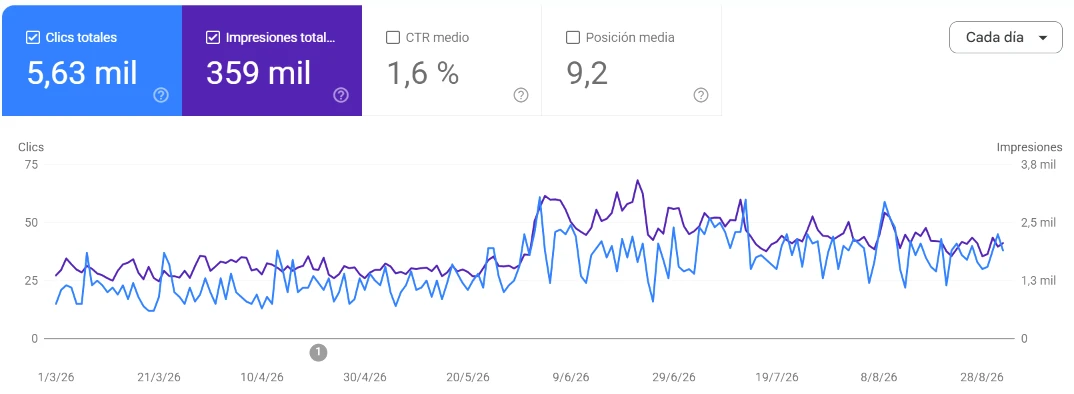
| Metrics | Before | After | Variation |
|---|---|---|---|
| Organic clicks | 794 | 1.224 | +54,16 % |
| Impressions | 46.906 | 80.168 | +70,91 % |
That’s 430 more clicks and 33,262 more impressions. The key point is that we hadn’t worked on any new keywords or changed the content architecture. Our efforts were focused on the platform.
Rankings depend on many factors, such as search demand, competition, and changes to Google’s systems. That’s why we can’t attribute all of the growth to technical improvements. What the data does confirm is that we redesigned the website without losing the visibility we wanted to protect, and, furthermore, our organic metrics improved significantly.
A foundation set for continued growth
Beyond Google, the company now has a modern, stable, secure, and easy-to-maintain website. This opens doors that were previously closed: expanding content, developing new SEO strategies, optimizing conversion rates, or gradually adding new features.
It also better prepares you for a change that’s already underway: AI-powered search. There are many unknowns about how it will evolve, but Google notes that SEO best practices remain valid for its AI-powered search experiences. A technically sound website with useful content doesn’t guarantee that you’ll appear in those results, but it’s the best starting point for adapting.
Redesigning a website is, above all, a strategic decision
When revamping a website, it’s easy to focus on everything that could be improved: a different design, a different architecture, new features, a broader SEO strategy. Often, these improvements make sense. But the value of a strategy lies not only in identifying opportunities. It lies in understanding the client’s situation, their resources, their timeline, and how much risk they can take on.
The most technically ambitious solution isn’t always the best fit for a business. Sometimes the right approach is to completely rethink the platform. Other times, as in this case, it’s best to preserve what works and focus efforts on improving it.
If you’re thinking about redesigning your website and are concerned about how it might affect your search engine rankings or your ability to attract customers, at Queiku we can help you assess your current situation and define the right strategy for your business.